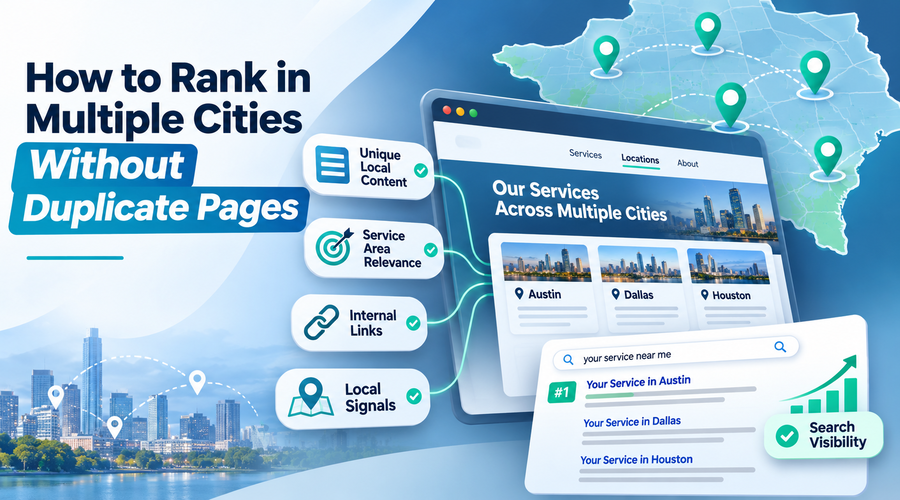
Businesses can rank across several cities without publishing nearly identical pages for every location they serve. A stronger approach is to build genuinely useful local content around real customer needs and service differences, which is how HiRISE Digital approaches SEO services in West Palm Beach and broader multi-location search strategies.
At HiRISE Digital, we focus on helping businesses turn local visibility into meaningful enquiries. In this guide, we’ll explain how to structure multi-city SEO, create genuinely useful location content, and measure whether your pages are helping people take the next step.
Why Duplicate City Pages Can Hold Back Local SEO
When a business serves multiple cities, it’s tempting to publish a page for every place on its service-area list. If each page repeats the same paragraphs and differs only in the city name, though, those pages offer little additional value. They may be difficult for search engines to distinguish, and they give visitors few reasons to choose one page over another.
There is an important difference between serving multiple locations and operating from multiple physical offices. A company can serve customers across a wide area without maintaining a storefront in every city. Your website should describe that reality clearly. Avoid suggesting you have a local office, staff, or address where you do not.
What makes a location page genuinely different?
A city page should provide information that is genuinely relevant to customers in that area. Relevant distinctions could include the types of projects commonly requested, local regulations that affect the work, neighborhoods included in the service area, travel or scheduling details, or examples of completed work nearby. Only include information you can verify and stand behind.
Not every city deserves its own page. If you cannot explain how the page will help a customer in that location, consider covering the area on a broader service-area page instead. A smaller set of detailed pages is often more useful than dozens of thin ones.
Start With a Practical Multi-City SEO Plan
Before creating location pages, identify your services, service areas, and the needs of customers in each location. This makes it easier to identify where separate pages are justified and where one broader page can serve several nearby communities. It also helps prevent competing pages from targeting the same search intent.
- List your services. Separate core services from optional add-ons and identify which ones are available in each city.
- Confirm your service areas. Document where you actually work, how customers are served, and whether any limitations apply.
- Research local search intent. Look for the questions, needs, and service terms people use in each area. Search results can reveal whether people expect a location page, a service page, or a specific answer.
- Choose page targets carefully. Create a page only when you can provide substantial, location-relevant information that supports a distinct search need.
- Plan internal links. Connect location pages to relevant service pages, helpful resources, and contact options so visitors can move naturally through your site.
For example, a home services business might serve West Palm Beach, Boca Raton, and nearby communities. It could create a dedicated page for a city where it has strong local experience and enough useful details, while listing smaller service areas on a regional page. This is more transparent—and more helpful—than treating every town as if the business had a separate branch there.
Build Location Pages Around Customer Value
A location page should clearly explain whether you serve the area, which services are available, what customers can expect after contacting you, and why your business is relevant to their needs.
Include useful, verifiable local details
Start with a clear description of the services available in the area. Add information that is genuinely relevant, such as common project types, nearby communities served, appointment expectations, or practical considerations affecting service delivery. If you have a real case study, testimonial, or project photo from the area, it may add helpful context—provided you have permission to share it and describe it accurately.
Local references should feel natural, not inserted just to repeat keywords. A paragraph listing nearby roads, landmarks, and neighborhood names is not automatically useful. Explain why the details matter to the customer, and remove anything that reads like a search-engine checklist.
Make each page easy to act on
Good local content also supports conversions. Include a clear next step, such as requesting an estimate, booking a consultation, or calling the business. Explain what information a visitor should provide and what they can expect after submitting a form. Useful calls to action reduce uncertainty and help visitors decide whether your business is the right fit.
Trust signals can make the page more persuasive. Depending on your business, these might include relevant qualifications, reviews, a clear explanation of your process, or examples of completed work. Keep claims specific and supportable. A page does not need to sound grand; it needs to give people a reason to contact the business.
Use Site Structure to Clarify Your Coverage
Organize your website so both visitors and search engines can understand the relationship between your services and locations. One option is to create a central service-area page that explains your coverage, then link to a focused page for each priority city. Service pages can describe what you do in depth, while location pages explain how those services are available in a particular area.
Keep page titles, headings, and URLs clear and descriptive. Avoid creating multiple URLs that target the same city and service combination unless each page serves a distinct purpose. Use internal links with natural anchor text, and make sure your navigation does not bury important pages several clicks deep.
For businesses with eligible physical locations, accurate business details across the website and business listings are important. Do not create a listing for a city where you do not have a qualifying location. For service-area businesses, follow the relevant platform guidelines and represent your address and coverage honestly.
Write for Local Intent, Not Just City Names
Keyword research can help you understand how customers describe their needs, but a page should not be created only around a keyword. Search terms such as search engine optimization Boca Raton or seo boca raton may indicate local interest in SEO services, yet the useful page is the one that explains the offering, who it helps, and how a business can get started—not one that repeats the phrase unnaturally.
Likewise, a business exploring SEO services in West Palm Beach should be able to find clear information about the provider’s approach and experience. HiRISE Digital can help businesses think through local search visibility as part of a wider digital strategy. The goal is to help people searching in those locations find accurate information about the services available to them.
Use related language where it fits: local search optimization, city service pages, nearby service areas, location-based keywords, and local lead generation. These concepts can add context, but they should support the reader’s understanding rather than become a checklist of phrases.
Measure Performance and Improve Over Time
Publishing a location page is the beginning, not the finish line. Track whether it reaches the right audience and helps visitors take useful actions. Search impressions and clicks can show how the page appears in search; engagement and enquiry data can help reveal whether the content meets visitor needs.
- Review organic visibility and search queries for each priority location.
- Check whether visitors reach the page through relevant searches and internal links.
- Monitor calls, form submissions, and other meaningful enquiries—not traffic alone.
- Look for outdated service information, broken links, or claims that need updating.
- Compare pages to identify gaps in usefulness, clarity, or conversion paths.
If a page attracts little relevant interest, assess its purpose before adding more keywords. It may need better local information, stronger links from related pages, or a clearer call to action. In some cases, combining overlapping pages into one stronger resource is the better choice. SEO improvements are most sustainable when they reflect how customers are actually served.
Common Mistakes to Avoid
Several shortcuts can undermine a multi-city strategy. Avoid copying a single template and changing only city names, publishing pages for locations you do not serve, or inventing local testimonials and project examples. Do not create near-identical pages simply to increase the number of URLs on your site.
Also avoid promising rankings or results that no provider can guarantee. Local visibility depends on many factors, including competition, the website, the searcher’s location, and the quality and relevance of the business information available online. Evaluate the strategy using both search visibility and business outcomes such as calls and form submissions.
Make Every Local Page Earn Its Place
Ranking in multiple cities does not require publishing a separate, repetitive page for every place on a map. It requires a clear understanding of where you work, what local customers need, and which pages can answer those needs with useful information. Accurate, distinct location pages can support search visibility while making it easier for potential customers to find relevant information and contact you.
Contact HiRISE Digital through our contact form or call (561) 346-9781 to discuss your service areas, existing location pages, and growth goals. Whether you need SEO Services West Palm Beach, search engine optimization Boca Raton, or a wider multi-city strategy, connect with our team and start building pages that give both search engines and customers a clear reason to choose your business.
Frequently Asked Questions
Should every city we serve have its own page?
No. Create a dedicated page when you can offer useful, distinctive information for that city, and it meets a clear customer need. If several nearby locations share the same service details, one well-organized regional page may be more appropriate.
How much content should a city page include?
There is no ideal word count for every page. Include enough original, accurate information to answer a visitor’s questions and help them take the next step. Prioritize usefulness and clarity over length.
Can we mention cities where we do not have an office?
Yes, if you genuinely serve customers there, you can explain that coverage accurately. Be clear about your business model, and do not imply that you have a physical location in a city when you do not.
What if two city pages have similar services?
Some overlap is normal, but each page should have a clear reason to exist. Add relevant differences grounded in your actual service experience. If you cannot do that, consider consolidating the pages.
How can we get help with a multi-city SEO strategy?
Start by reviewing your current pages, service areas, and enquiry paths. Then use the HiRISE Digital contact form or call the phone number listed on our website to discuss a practical approach for your business.